
Lower Eyelid Treatments at a Glance
Excess skin, fat prolapse, tear troughs and shadowing – causes and treatment options for tired lower eyelids.
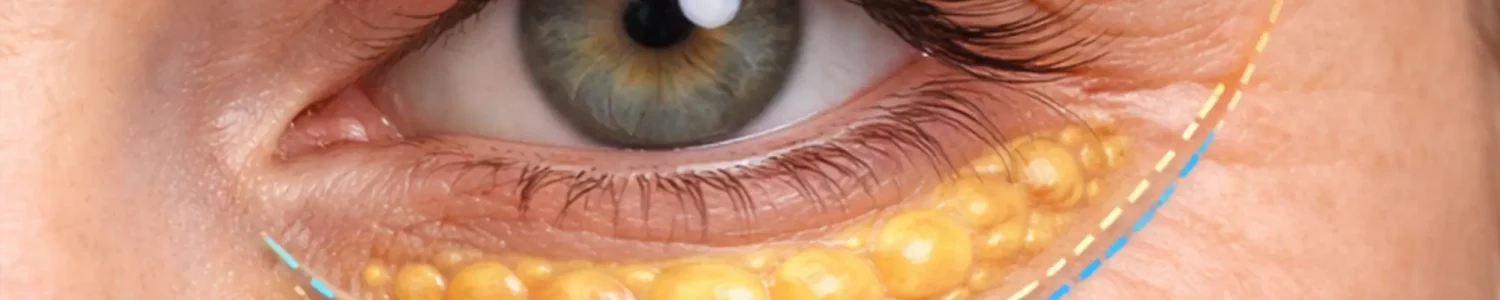
Swelling or so called “eye bags” under the eyes are among the most common reasons patients seek consultation in aesthetic facial surgery. Many people initially assume that every bulge under the eyes has the same cause. In reality, several different anatomical changes can be responsible.
The most common diagnoses in the lower eyelid area include:
• Dermatochalasis, meaning excess skin of the lower eyelid
• Fat prolapse, meaning bulging orbital fat pads
• Shadowing, caused by thin skin and a visible orbicularis oculi muscle
• Tear trough, a depression between the lower eyelid and the cheek
These conditions may occur individually or in combination. For this reason, a careful evaluation of the lower eyelid region is essential before deciding on treatment.
Incidentally, the term “eye bags” is actually misleading. Many people assume that the swelling under the eyes is related to tear fluid or the tear glands. However, this is not the case.
Tears are produced in the lacrimal gland located in the upper outer part of the eye and drain through small ducts near the inner corner of the eye. This process has no anatomical connection to the structures of the lower eyelid.
1. Dermatochalasis of the Lower Eyelid – when excess skin develops
With increasing age, the skin gradually loses elasticity and firmness. The skin of the lower eyelids is particularly thin and sensitive to this process.
Typical signs include:
- fine wrinkles of the lower eyelid
- loose skin
- excess skin
- a tired facial expression
The main problem in this situation is skin laxity and reduced structural support of the eyelid tissues.
Surgical treatment of excess skin
Transcutaneous “open” lower eyelid blepharoplasty
The classic treatment is transcutaneous lower eyelid blepharoplasty.
Access is obtained through a fine incision just below the lash line.
Through this approach, several steps can be performed:
- removal of excess skin
- tightening of the eyelid muscle
- stabilization of the lateral canthus with a canthopexy
- treatment of fat pads if necessary
The goal is a natural tightening of the lower eyelid without altering the shape of the eye.
The scar lies directly below the eyelashes and is usually barely visible after healing.
Laser or other energy based technologies
In addition to surgical methods, there are also skin tightening procedures using laser or other energy based technologies. The advantages and disadvantages of these techniques are discussed later in this article.
2. Fat Prolapse – when fat pads bulge forward
Another common cause of “eye bags” is protrusion of orbital fat. Several fat compartments are located within the eye socket and are normally held in place by connective tissue structures. With age, these structures can weaken.
As a result, the fat bulges forward.
Typical features include:
- visible bulging under the eye
- relatively good skin quality
- minimal excess skin
Surgical treatment of fat prolapse – Transconjunctival “closed” fat removal
When fat is the main cause, a transconjunctival lower eyelid procedure can be performed.
The incision is made on the inside of the eyelid through the conjunctiva.
Advantages of this technique include:
- no visible scar
- a very gentle surgical approach
- targeted removal or repositioning of fat tissue
- the skin remains untouched
This method is particularly suitable for patients with good skin quality.
3. Under Eye Shadowing – when the eye muscle becomes visible
Not every dark area under the eye is caused by excess skin or fat. The skin of the lower eyelid is one of the thinnest skin areas of the entire body. Directly beneath it lies the orbicularis oculi muscle, the circular muscle surrounding the eye.
When the skin is very thin, this muscle may become visible through the skin. This creates a darker area or shadow under the eye.
This effect is commonly perceived as dark circles.
In rare cases, especially in darker skin types, increased pigmentation may also contribute to dark discoloration in this region.
Treatment Options for Under Eye Shadows
Depending on the cause, several treatment options are available. These treatments aim to strengthen the skin structure and reduce the visibility of underlying muscle and vessels.
Nanofat and Microneedling
A modern method is the combination of nanofat and microneedling.
Nanofat is highly processed autologous fat. A small amount of fat is harvested from another body area, for example the abdomen or hips. The fat is then processed and filtered to obtain a very fine, cell rich liquid.
Nanofat mainly contains:
- regenerative fat cells
- stem cells from adipose tissue
- growth factors
Unlike traditional fat grafting, nanofat is used less for volume restoration and more for improving skin quality.
During microneedling, the skin is stimulated with very fine needles, creating tiny microchannels.
These microinjuries lead to two key effects:
- stimulation of collagen and elastin production
- improved penetration of regenerative substances
When nanofat is combined with microneedling, the regenerative components can penetrate into deeper skin layers where they exert their effect.
Over time, the skin becomes less transparent, reducing the visibility of muscles and vessels and improving dark circles.
Polynucleotides
Polynucleotides are a relatively new regenerative treatment option for the lower eyelid area. These biologically active DNA fragments are usually derived from purified salmon DNA and are used to improve skin quality.
Polynucleotides act as biostimulators rather than fillers.
They can stimulate:
- fibroblast activity
- collagen and elastin production
- skin hydration
- cellular regeneration
- antioxidant and anti inflammatory processes
In the thin lower eyelid skin, this may lead to improved skin thickness and structure, making underlying muscle and vessels less visible.
PRP Treatment for Dark Circles
Another regenerative treatment option is PRP (Platelet Rich Plasma).
A small amount of blood is taken from the patient and centrifuged to isolate plasma rich in platelets and growth factors.
These growth factors can stimulate:
- collagen production
- improved microcirculation
- cellular regeneration
- improved skin thickness and structure
As the skin becomes thicker and more stable, the underlying muscle and vessels become less visible, reducing the appearance of dark circles.
4. The Tear Trough – the “valley of tears”
The tear trough is a natural depression between the lower eyelid and the upper cheek.
It develops due to several anatomical factors:
- ligamentous structures between eyelid and cheek
- different fat compartments
- the shape of the cheekbone
- volume loss in the midface
With age, the tear trough often deepens, creating a shadow under the eye that is perceived as tiredness.
It is therefore not just a skin issue but a three dimensional structural change of the midface.
Treatment Options for the Tear Trough
Possible treatments include:
- hyaluronic acid fillers
- autologous fat grafting
- surgical fat repositioning + septal reset
Hyaluronic acid
A very common treatment is the careful correction with hyaluronic acid filler.
This helps to compensate for the depression and reduce the shadow.
The effect occurs through several mechanisms.
1. Volume correction of the depression
The most important effect is the three-dimensional restoration of volume. Hyaluronic acid is usually injected deep on the bone or within a stable tissue layer.
This slightly elevates the sunken tear trough area.
As a result, the transition between the lower eyelid and the cheek becomes smoother.
The shadow line disappears or becomes significantly reduced.
2. Change in light reflection
A major part of the effect results from changes in light reflection. Before treatment, a shadow forms because light is refracted by the depression.
When the depression is corrected, light reflects more evenly.
This makes the area under the eye appear brighter and more refreshed.
3. Hydration of the skin
Hyaluronic acid has a strong ability to bind water. This often improves hydration in the lower eyelid skin. The skin may appear slightly fuller and fine lines can soften.
However, this effect is usually a secondary benefit, not the primary mechanism of treatment.
4. Improvement of tissue support
By restoring volume, the support of the tissue between the lower eyelid and cheek also improves. The skin lies more evenly over the underlying structures, creating a more harmonious and less sunken appearance.
Further details about the specific aspects of treating the tear trough with hyaluronic acid can be found at the end of this blog article.
Autologous fat (fat grafting)
In addition to hyaluronic acid, autologous fat can also be used to treat the tear trough.
A small amount of fat is harvested from another part of the body, such as the abdomen or hips.
The fat is processed and then transplanted into the lower eyelid area.
The goal is similar to hyaluronic acid treatment:
the depression between the lower eyelid and cheek is corrected and shadowing is reduced.
A key advantage of autologous fat is that it is the patient’s own tissue, which provides several benefits:
- long-lasting results
- natural tissue integration
- regenerative effects
- lower risk of material migration
However, some aspects must also be considered:
- unpredictable fat survival rate
- more difficult to correct if necessary
- minor surgical procedure required for fat harvesting
Because fat harvesting requires a small liposuction procedure, the treatment is more complex than a simple filler injection.
Combination with lower eyelid surgery
If fat prolapse or excess skin is present at the same time, a combination of surgery and volume restoration may be useful.
Many patients present with a combination of:
- protruding fat in the lower eyelid
- a sunken tear trough below it
With classical fat removal, only the protruding fat would be reduced. Modern lower eyelid surgery often follows a different concept.
Instead of removing the fat completely, the surgeon repositions the fat into the tear trough.
This technique is called fat repositioning.
The surgeon carefully releases the fat pads from their original position and distributes them into the tear trough depression.
This smooths the transition between the lower eyelid and cheek.
The major advantage of this method is that the patient’s own tissue is used to restore the volume.
Septal reset
Another surgical technique used for treating the tear trough is the septal reset. In this method, not only the fat is repositioned but also the anatomical barrier between the orbital fat and the lower eyelid is repositioned.
Normally, the orbital fat is held back by the orbital septum, a connective tissue layer that runs from the bony orbital rim to the lower eyelid.
With aging, two things may occur simultaneously:
- the fat pushes forward
- a depression develops in the tear trough area
This creates a clear transition between bulging and hollowing.
During a septal reset, the orbital septum is released and then fixed lower, usually at the tear trough ligament or the orbital rim.
This creates a new effect:
- the fat is again held back
- the tear trough depression is corrected
The procedure therefore uses the existing anatomical structures to smooth the transition between the lower eyelid and the cheek.
Downtime after lower eyelid surgery
Healing time depends on the procedure and individual healing response.
Typical course:
First 2–5 days
Swelling and bruising are normal and can sometimes be quite pronounced.
Cooling and physical rest support healing.
After about 7–14 days
Sutures are removed if an external incision was performed.
Many patients feel socially presentable again.
After 2–3 weeks
Most swelling and bruising have largely subsided.
After 4–6 weeks
The final result becomes increasingly visible.
After 8–12 weeks
Redness of the scars decreases significantly.
After 4–6 months
The scars appear white and are barely visible.
Possible complications
Lower eyelid surgery is generally a very safe procedure in experienced hands.
However, as with any surgical procedure, complications may occur.
Possible risks include:
• swelling and bruising
• temporary dryness of the eyes
• irritation of the conjunctiva
• rare infections
• temporary eyelid malposition (scleral show, ectropion)
Careful surgical technique and stable eyelid fixation, for example through canthopexy or muscle suspension, contribute significantly to procedural safety.
Special considerations when treating the tear trough with hyaluronic acid
Tear trough treatment with hyaluronic acid can achieve very good results but is considered one of the more technically demanding filler treatments of the face. The lower eyelid region is anatomically delicate and constantly moves through blinking and facial expression.
For this reason, certain effects may occur in rare cases.
Hyaluronic acid migration
In some cases, hyaluronic acid may shift within the tissue over time.
This is known as filler migration.
The lower eyelid region is particularly prone to this because of:
- very thin skin
- limited stable tissue layers
- constant movement of the orbicularis oculi muscle
- gravitational effects over time
As a result, the filler may slowly move into adjacent tissue areas.
These changes may sometimes become visible months or even years later.
Lymphatic congestion and swelling
Another possible reaction is persistent swelling of the lower eyelid.
The area under the eye contains a very delicate lymphatic system responsible for fluid drainage.
If hyaluronic acid is present in this region, it may:
- exert pressure on lymphatic vessels
- impair fluid transport
- bind water
Because hyaluronic acid strongly retains water, certain particle sizes or highly cross-linked fillers may lead to increased fluid accumulation.
This may appear as:
- soft swelling under the eye
- often more pronounced in the morning
- sometimes slightly bluish skin
Treatment options for such problems
One important safety feature of hyaluronic acid fillers is their reversibility. Hyaluronic acid can be dissolved using an enzyme called hyaluronidase.
If necessary, ultrasound imaging can help guide treatment.
The enzyme is injected into the treated area and breaks down the hyaluronic acid within a short time.
This allows:
- reduction of excess material
- resolution of swelling
- restoration of a more natural tissue appearance
This reversibility makes hyaluronic acid a highly controllable and adjustable treatment option compared with many other materials.
Skin tightening of the lower eyelid with laser or energy-based treatments
Besides surgical methods, there are also procedures that tighten the lower eyelid skin using laser or other energy-based technologies, including:
- CO₂ laser
- erbium laser
- radiofrequency or plasma-based devices
- fractional laser resurfacing technologies
These methods work by delivering controlled thermal energy into the skin. This partially removes the superficial skin layer and stimulates collagen formation in the dermis, aiming to improve fine wrinkles and mildly tighten the skin.
CO₂ lasers in particular can penetrate relatively deeply and produce visible tightening.
However, the deeper penetration also carries a higher risk of thermal tissue damage.
Risks in the sensitive lower eyelid region
The skin of the lower eyelid is among the thinnest in the body, making it particularly sensitive to thermal energy.
Possible complications include:
- burns
- scarring
- pigment changes
- Infection or delayed wound healing
Results and long-term effects
Laser and energy-based treatments can produce visible improvement in cases of:
- fine wrinkles
- mild skin laxity
- superficial skin changes
However, the degree of tightening is usually limited.
In cases of significant skin excess or structural changes, results are often less convincing than with surgical lower eyelid procedures.
Clinical experience shows that laser treatments are typically a complementary or mild alternative, while surgical procedures provide more stable long-term results in more advanced cases.
Summary
Changes in the lower eyelid area are among the most common causes of a tired or exhausted facial appearance.
Several anatomical factors may contribute, including:
- excess lower eyelid skin (dermatochalasis)
- protruding fat (fat prolapse)
- a pronounced tear trough
- shadowing due to thin skin and visible muscle
These changes may occur individually or in combination.
For this reason, a careful analysis of the lower eyelid anatomy is essential before planning treatment.
Depending on the underlying cause, different treatment options are available, including:
- surgical procedures such as lower eyelid blepharoplasty or transconjunctival fat removal
- minimally invasive treatments such as hyaluronic acid fillers
- autologous fat transfer
- nanofat or regenerative treatments to improve skin quality
The goal of every treatment should always be a natural and harmonious result.
The eyes should appear fresher and more rested, without altering the individual anatomy or character of the face.
A personalized treatment plan is therefore the most important step toward achieving an optimal result.